
Part Two: Designing Products for Rotational Molding
Undercuts
Part Two: Designing Products for Rotational Molding
UndercutsUndercuts
In rotomolding, the term “undercut” refers to any inwardly or outwardly projecting section that is parallel to the parting line of the mold. Such a feature of any size will require the part to be deformed in order to release it from the mold. In this respect, the shrinkage of polyethylene is helpful, as is the material’s relative flexibility at typical demolding temperatures.
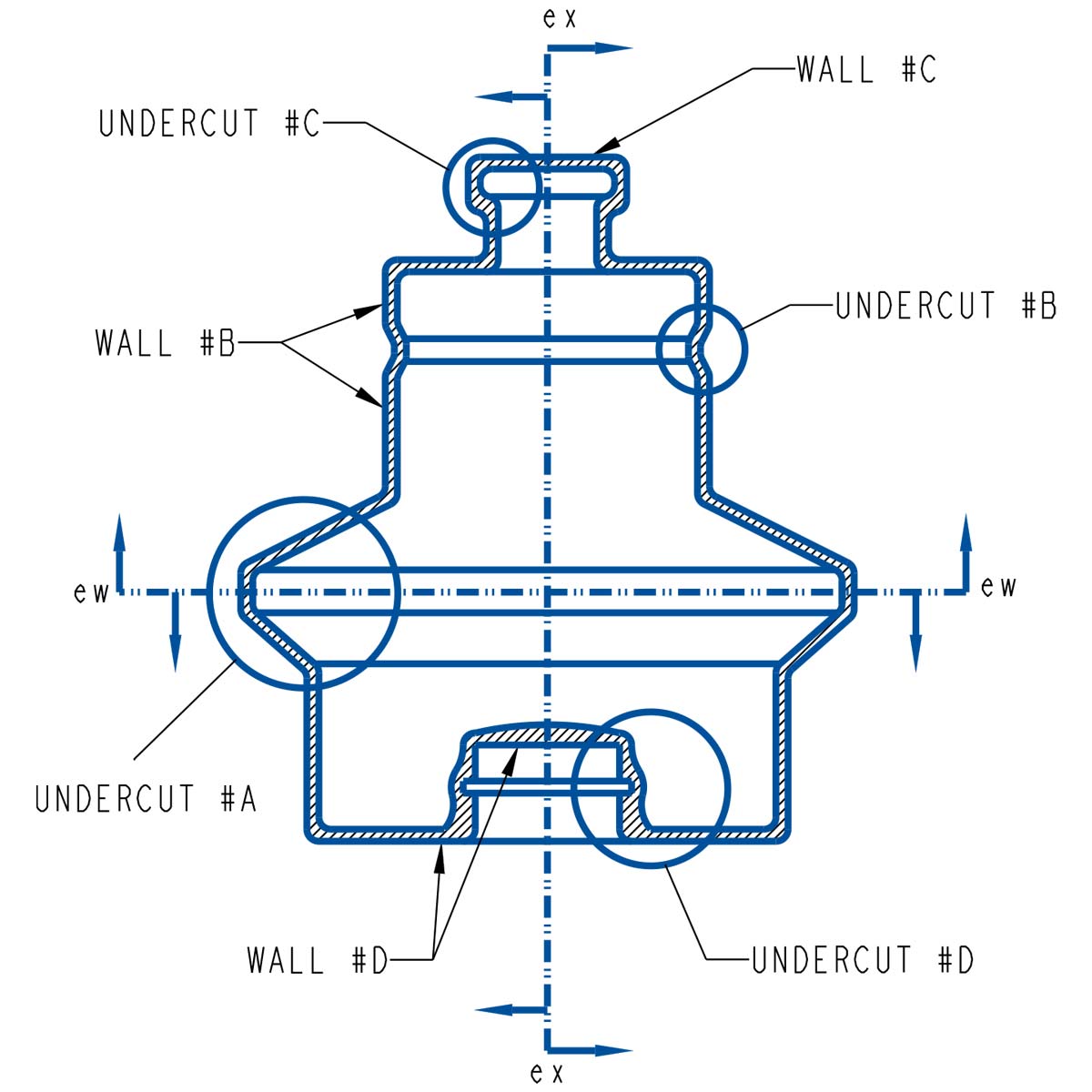
It is difficult to be precise about the design of undercuts for rotomolded parts, because circumstances vary so much. Each different type of undercut will require a different set of considerations (Fig 33):
- The deep undercut “A” could best be avoided by locating the parting line of the mold as shown at “W-W.”
- Undercut “B” can probably be demolded if the plastic material will deform sufficiently to accommodate its depth. Removal from the mold will be enhanced if the shape of the undercut encourages the inward deformation of walls “B.”
- Undercut “C” will be difficult or may be impossible to remove from the cavity with a polyethlene part; the location of Wall “C” reinforces the undercut and makes it difficult to deform inwardly. A separate removable section of the mold may need to be provided.
- Undercut “D” is similar to “C”; whether or not it can be demolded is dependent upon the flexibility of the plastic material, the amount of material shrinkage, the depth and shape of the undercut, and its location in relationship to the two reinforcing walls “D”.
In many cases, ease of demolding will be improved by the use of higher slip mold release agent on the affected section of the mold.
Whilst a simple two-piece mold will usually be the lowest cost option, provision of removable sections can solve many undercut issues.