
Part Two: Designing Products for Rotational Molding
Flatness Considerations
Part Two: Designing Products for Rotational Molding
Flatness ConsiderationsFlatness Considerations
Rotationally molded parts, like blow-molded parts, are formed in hollow molds, typically without internal structure. This means that the inside surface of the part is, in effect, free-formed. On large flat surfaces, there may be a tendency for the middle of the area to be depressed relative to the outside of the area, creating an internal bowing effect. This tends to become more pronounced as wall thickness increases.
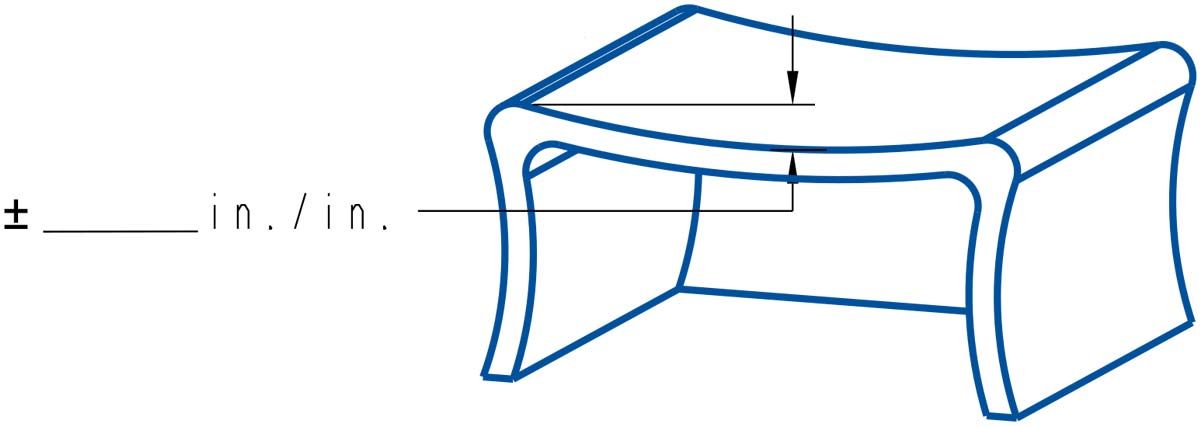
The designer should give consideration to large flat surfaces that have functional or cosmetic attributes. A commercially acceptable flatness tolerance on a polyethylene part would fall in the range of ±0.020 to 0.030 inches per inch (see Fig 15). A precision tolerance of ±.010 inches per inch may be achieved with quality tooling and controlled processing techniques.
Alternative strategies would be to break up flat areas with surface features, or design-in a slight outward contour.
Whilst it is often preferred to avoid large flat surfaces when designing rotationally molded parts, it is possible to incorporate such surfaces if necessary. Experienced molders working with rotationally molded parts containing large flat surfaces can utilize a range of techniques. Flat surfaces may be supported with reinforcing ribs and some designs have successfully incorporated crowns of approximately 0.015 inch-per-inch on flat surfaces. It is also common to use secondary fixtures as a way to ensure that the molded part maintains its shape during post-mold cooling. Some designs incorporate textures, decoration or engraved lettering on flat surfaces, in order to draw attention away from the lack of flatness.